
Repainting a wooden garage door in Calgary.
Wood moves. In a city where the temperature can swing 30°C in a day, that movement is the whole reason wood doors are repainted more often than steel ones — and the whole reason edge sealing matters more than anything else you do.
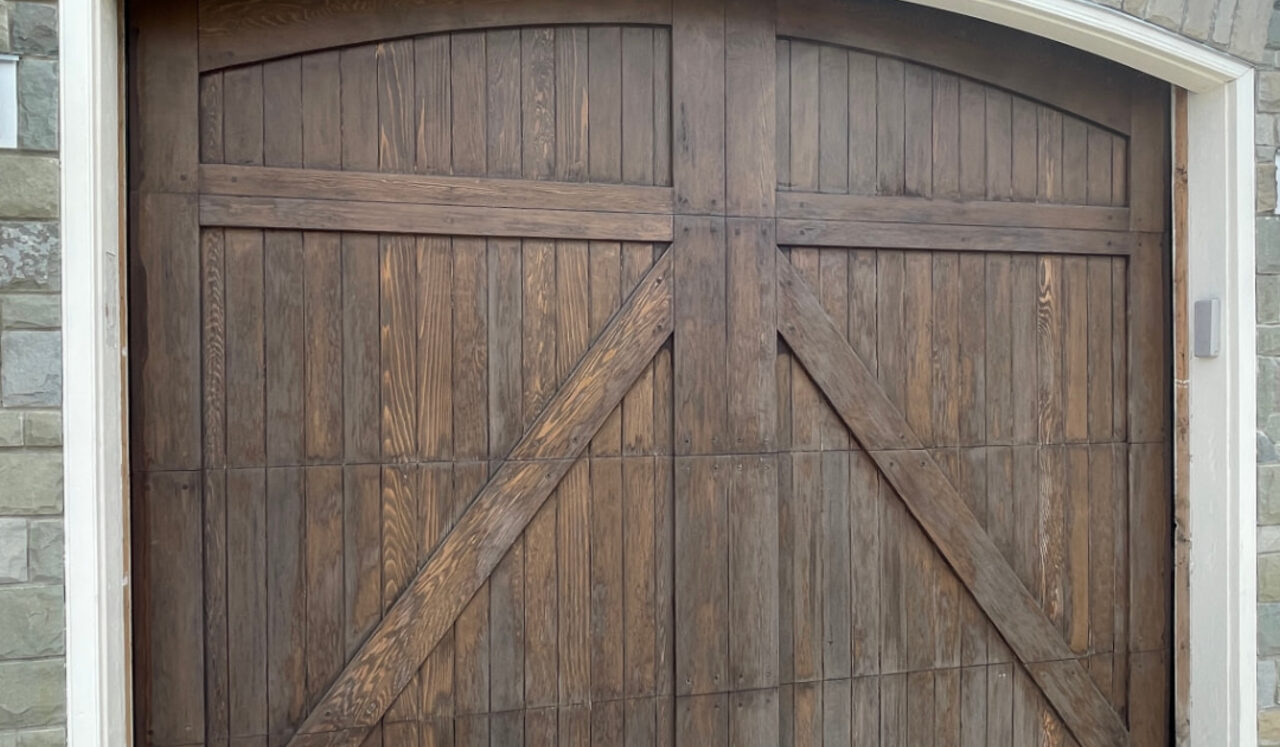
How do you repaint a wooden garage door?
Why wood is a different job from steel
A steel door is dimensionally stable; it expands and contracts, but it does not absorb anything. A wood door takes on and gives up moisture with every weather change, swelling and shrinking as it goes. In Calgary, where chinooks push the temperature 30°C or more inside a day and the humidity moves with it, that cycle runs constantly.
Everything about the coating choice follows from that. The primer and the finish both have to stay flexible, because a brittle film on a moving substrate cracks — and every crack is a route for water into the wood underneath. It is also why a wood door here realistically gives five to seven years between repaints, where a properly primed steel door gives seven to ten.
All six sides, not one
The single biggest difference between a wood door repaint that lasts and one that fails is whether the edges were sealed. The face you see is easy. The top edge, the bottom edge and the sides of each panel are the ones that get skipped, and they are exactly where end grain is exposed.
End grain behaves like a bundle of straws. Left unsealed, the bottom edge wicks up meltwater and salt slush all winter, the wood swells, and the coating on the face lifts from below. If you only take one thing from this page, seal the bottom edge.
- Bottom edge — the priority, sitting in meltwater and salt every winter
- Top edge — hidden, and the one nobody checks
- Panel side edges, where they meet the stiles
- The inside face, if the garage is unheated and gets condensation
Fixing what the winters have already done
Most Calgary wood doors we look at have some combination of the same three things: a grey, dry patch on the sun-facing lower panels, a split or two where a panel has moved against its frame, and soft wood along the bottom rail.
Grey and dry is fine — sand it back to clean wood and prime it. Splits get filled and sealed. Soft wood is the one to look at honestly: if you can press a screwdriver into the bottom rail, that section needs a wood repair or replacement before it is worth painting, because paint over rot just makes rot you cannot see.
Stain or paint?
A stained wood door on a Calgary elevation is beautiful and needs more attention. Semi-transparent stains give up their UV protection faster at 1,100 m with 333 sunny days a year, so a stained south-facing door often wants a maintenance coat every three to four years.
Paint hides the grain but holds much better. If the door is already painted, going back to stain means stripping it, which is rarely worth the labour. If it has never been coated and you want the wood to show, plan on the shorter maintenance cycle before you commit.
Timing it
May through September, above 5°C, with the wood dry going in. Wood is less forgiving than steel about damp: a door washed in the evening and coated the next morning may still be holding moisture in the end grain, and that moisture has nowhere to go once the film closes over it.
Give yourself two dry days if you can — one to wash and prep, one to prime and coat. Then keep the door closed four to six hours after the final coat so the fresh edges do not stick to the weatherstripping.
Questions people ask
How often does a wood garage door need repainting in Calgary?
Every five to seven years for a painted door, and every three to four for a semi-transparent stain on a sun-facing elevation. The constant expansion and contraction from chinook cycling is what shortens the interval compared with steel.
Do I have to paint the inside of the door too?
In an unheated Calgary garage, yes — coat it. The inside face sees condensation through the winter, and sealing only one side of a wood panel encourages it to cup as one face takes on moisture the other cannot.
Can I paint over a stained wood garage door?
Yes, with a bonding exterior primer suited to the old finish. Going the other direction — paint back to stain — means stripping the door, which is usually more labour than the result is worth.
What if the bottom of my wood door is soft?
That is rot, and it needs a wood repair or a replaced bottom rail before painting. Coating soft wood seals moisture in and hides the damage while it keeps spreading.
Is a flexible enamel really necessary?
On wood in Calgary, yes. The door changes dimension with every significant weather swing, and a hard, brittle film cracks along the joints. Cracks are how water gets into the wood, so flexibility is what protects the substrate.
10+ years on the tools
Coatly is a new name, but not a new crew. The people on your job have been painting Alberta homes for over a decade.
Insured
We carry liability insurance. Want to see the certificate before we start? Ask and we send it over.
A number in minutes
Interior residential estimates come back while you are still on the page — not after three days of phone tag.
Related work we do
- Garage door paintingYour garage door is the largest single surface on the front of most Calgary houses, and it…
- Fence & deckHorizontal wood takes the worst of it here — snow load, meltwater, then hard UV. Cleaned, …
- Exterior paintingSiding, stucco, trim, fascia, doors and garages. Calgary's freeze-thaw swings and thin-air…
Budget ranges live in the Alberta painting cost guide, and you can book a Calgary painting crew.
Keep reading
- ClimateChinooks & paint failureA chinook can move the temperature 20–30°C in a few hours, dozens of times a winter. Each swing works moisture behind the coating and breaks the bond. Prep, not price per litre, is what survives it.
- ClimateHail & repaintingHail pits paint film as well as denting panels. Painting over unrepaired siding buries the problem and can complicate an insurance claim — settle the claim and repair the substrate first, then paint.
- TimingBest time to paintMost exterior coatings need day and overnight temperatures above about 10°C to cure, which makes late May to mid-September the dependable window. Everyone books the same four months, so quote in spring.
- Colour2026 coloursBenjamin Moore named Silhouette AF-655 its 2026 Colour of the Year; Sherwin-Williams chose Universal Khaki SW 6150. Both suit our light better than the cool greys that dominated the last decade.
- SubstrateStucco vs HardieStucco is porous and cracks with wall movement, so it needs breathable coatings and real crack repair. Fibre cement is dimensionally stable and the most paint-friendly cladding in the city.
Skip the week of waiting.
Upload a photo, see the colour on your own wall, and get a real number in minutes. Or just call and talk to someone who paints for a living.
Calgary, Alberta · Mon–Sun 9am–8pm MT · Estimates are estimates, never a contract.