
Why chinooks and freeze-thaw wreck exterior paint in Calgary.
No other major Canadian city cycles a wall through freezing and thawing as often as Calgary does. It is the single biggest reason exterior paint here fails years earlier than the label promises.
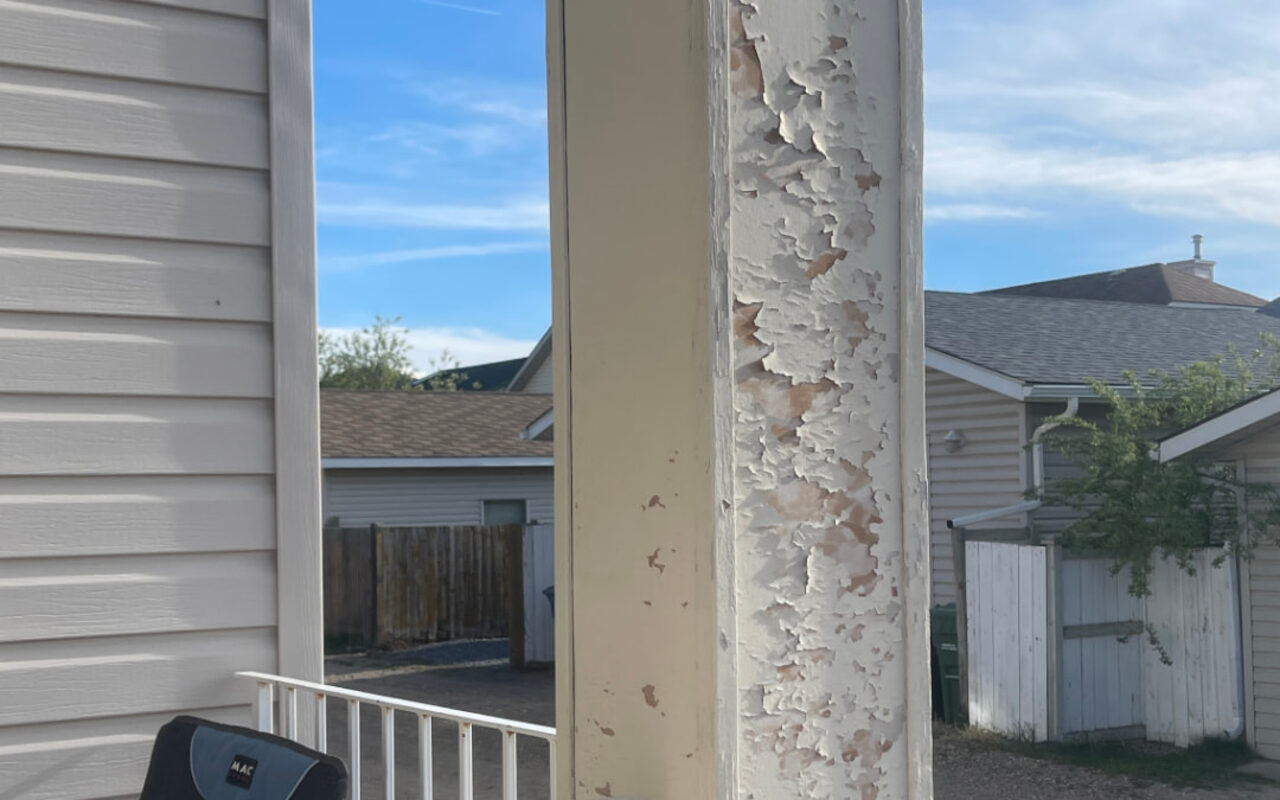
Why does exterior paint fail faster in Calgary than elsewhere?
What actually happens to the film during a chinook
A chinook arch appears over the foothills, the wind shifts to the west, and the wall of your house goes from -18°C to +8°C before lunch. The cladding, the fasteners and the paint film all expand at different rates. Paint is the thinnest and least forgiving of the three, so the stress concentrates at its weakest points: edges, seams, fastener heads, and any place the film is already thin.
Meanwhile, snow sitting against the north foundation or in a soffit line melts. That water follows gravity and capillary action into hairline cracks, lap joints and end grain. When the temperature drops again overnight — and in Calgary it usually does — the water expands about nine percent as it freezes and pushes the coating away from the substrate from behind.
Do that thirty times a winter for four winters and you get the failure pattern every Calgary painter recognises: intact paint across most of a wall, and blistering or sheet peeling on the south and west elevations and around every window sill.
- Edge lifting on trim, fascia and window casing — the first visible symptom
- Blistering on south and west walls where UV has already embrittled the film
- Stucco cracks widening season over season rather than staying static
- Peeling in a horizontal band above grade where snow piles against the wall
Which claddings fail first here
Acrylic stucco, which covers a large share of Calgary homes built between roughly 1975 and 1998, is porous and moves with the wall behind it. It handles chinooks well when it is sound and coated with something breathable, and badly when it has been sealed with a film that traps moisture inside.
Wood — cedar shakes, fir trim, older fascia and any painted deck rail — is the most freeze-thaw sensitive material on the house because it absorbs water directly. Fibre cement (Hardie and similar) is the most stable and the most forgiving to repaint. Vinyl and aluminium siding move a lot dimensionally, so they need coatings formulated to flex and a colour no darker than the manufacturer's heat limit.
- Wood trim and cedar: highest risk, needs back-priming and end-grain sealing
- Acrylic stucco: needs elastomeric-style breathable coating, not a sealer
- Fibre cement: lowest risk, standard 100% acrylic exterior performs well
- Vinyl: use vinyl-safe colours or the panel warps in July sun
The prep that actually survives a Calgary winter
The difference between a repaint that lasts four years and one that lasts ten is almost entirely what happened before the first coat. Pressure washing to remove chalking, scraping and feather-sanding every failed edge, spot-priming bare substrate, and filling cracks with a flexible sealant rather than rigid filler are the four steps most commonly skipped by the cheapest quote in your inbox.
Moisture content matters more here than most homeowners expect. Painting a wall that read 18% moisture in the morning because snow melted against it the day before guarantees a bond failure by spring, no matter how good the paint is.
- Wash and let dry a full day, not an hour
- Scrape to sound edges, then feather-sand so the transition disappears
- Spot-prime every bare patch — bare stucco and bare wood both drink primer
- Flexible sealant on cracks and joints so the repair can move with the wall
- Two finish coats at the manufacturer's spread rate, not one stretched coat
How long an exterior repaint should last in Calgary
On fibre cement with good prep, eight to twelve years is realistic. On sound stucco with a breathable coating, seven to ten. On wood siding or heavily exposed south-facing elevations, five to eight, with trim often needing attention sooner than the field.
If your last repaint failed inside four years, the paint was almost certainly not the problem. Either it went on over damp or chalky substrate, or the cracks underneath were never repaired.
Questions people ask
How many chinooks does Calgary get in a winter?
Calgary typically experiences 30 to 35 chinook events per winter, more than any other major Canadian city. Each one can raise the temperature 20 to 30 degrees Celsius within a few hours, then let it fall again overnight.
Can you paint a house exterior in Calgary in winter?
Generally no. Most exterior coatings need surface and air temperatures above roughly 10°C during application and through the overnight cure. A single warm chinook afternoon is not enough because the temperature drops before the film has cured. Exterior work runs late May to mid-September here.
Is elastomeric paint worth it in Calgary?
On stucco, usually yes — a flexible breathable coating bridges hairline cracks and moves with the wall through freeze-thaw cycling. On wood or fibre cement it is normally unnecessary, and on damp substrate it can trap moisture and make failure worse.
Why is only one side of my house peeling?
South and west elevations take the most UV and the most chinook-driven temperature swing, so the film embrittles and loses adhesion there first. It is the normal Calgary failure pattern, not a sign of defective paint.
10+ years on the tools
Coatly is a new name, but not a new crew. The people on your job have been painting Alberta homes for over a decade.
Insured
We carry liability insurance. Want to see the certificate before we start? Ask and we send it over.
A number in minutes
Interior residential estimates come back while you are still on the page — not after three days of phone tag.
Related work we do
- Exterior paintingSiding, stucco, trim, fascia, doors and garages. Calgary's freeze-thaw swings and thin-air…
- Stucco paintingCalgary is a stucco city — and stucco is the surface freeze-thaw punishes hardest. Painted…
- Siding paintingHardie, vinyl, wood and aluminium each fail differently and each need different prep. Gett…
Budget ranges live in the Alberta painting cost guide, and you can book a Calgary painting crew.
Keep reading
- ClimateHail & repaintingHail pits paint film as well as denting panels. Painting over unrepaired siding buries the problem and can complicate an insurance claim — settle the claim and repair the substrate first, then paint.
- TimingBest time to paintMost exterior coatings need day and overnight temperatures above about 10°C to cure, which makes late May to mid-September the dependable window. Everyone books the same four months, so quote in spring.
- Colour2026 coloursBenjamin Moore named Silhouette AF-655 its 2026 Colour of the Year; Sherwin-Williams chose Universal Khaki SW 6150. Both suit our light better than the cool greys that dominated the last decade.
- SubstrateStucco vs HardieStucco is porous and cracks with wall movement, so it needs breathable coatings and real crack repair. Fibre cement is dimensionally stable and the most paint-friendly cladding in the city.
- HiringHiring a painterAlberta requires a prepaid contracting licence for anyone taking payment before work is complete, and you can verify a business through Service Alberta. Ask for proof of insurance, a written scope and a product list.
Skip the week of waiting.
Upload a photo, see the colour on your own wall, and get a real number in minutes. Or just call and talk to someone who paints for a living.
Calgary, Alberta · Mon–Sun 9am–8pm MT · Estimates are estimates, never a contract.